
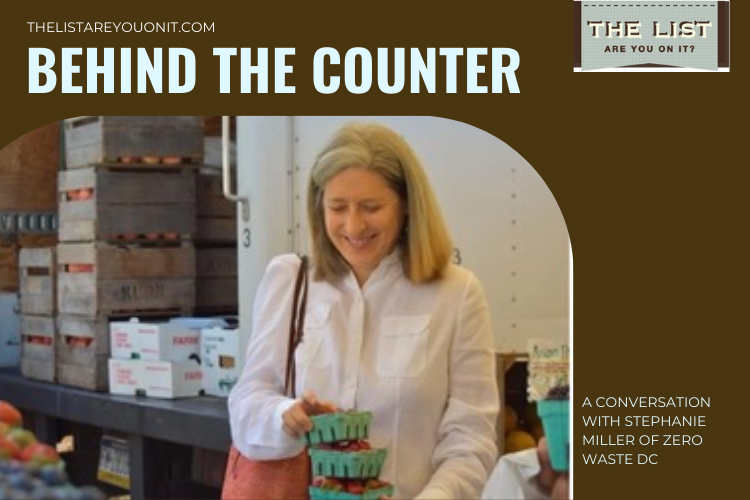
Behind The Counter: Stephanie Miller of Zero Waste DC
TheListAreYouOnIt.com has been a big fan of Stephanie Miller and her commitment to zero-waste living for years. She’s joined us on both Foodie & The Beast and Industry Night, and we’re thrilled to feature her here for our Behind The Counter Buzz column.
Stephanie J. Miller is the former Director of Climate Business at the World Bank Group and the author of Zero Waste Living, the 80/20 Way: The Busy Person’s Guide to a Lighter Footprint. She founded Zero Waste in DC, where she reaches wide audiences through sustainability consultations, keynote presentations, and learning events. She’s also the founder of DC Reduces, a grassroots initiative helping local businesses and consumers reduce single-use packaging. Stephanie’s work is all about making sustainability practical, approachable, and — yes — actually doable.
How did you get into this line of work, and what do you focus on now?
I’ve always considered myself a conservationist and spent 25 years working on climate change at the private sector arm of the World Bank Group, focusing on energy efficiency and renewable energy in developing countries. When I left that role, I started looking closely at what I could do in my everyday life. The first step was asking my neighborhood dry cleaner, President Valet, to return my clothes in a reusable garment bag instead of plastic. They said yes and eventually adopted a reusable bag program. That small change made me wonder what else was possible. I discovered the zero-waste movement, which aims to dramatically reduce what we send to landfills, incinerators, and waterways. While a true “mason jar of trash per year” lifestyle isn’t realistic for most people, I advocate for low-waste living — small, accessible changes that add up. That led to my book, and to launching Zero Waste in DC and DC Reduces to help people take easy, meaningful steps toward sustainability.
Microplastics are everywhere. Is there anything we can actually do to reduce exposure?Microplastics and nanoplastics are now found everywhere — from mountain peaks to ocean depths — and they enter our bodies through the air we breathe and the food and drinks we consume. While the health impacts are still being studied, many medical professionals are increasingly concerned. One of the biggest actions people can take is to avoid heating food in plastic. Heat causes plastic and its chemicals to leach into food and drinks. Transfer leftovers from plastic containers into glass or ceramic before microwaving, and swap out plastic utensils when possible. To reduce plastic particles in your home, dust and mop regularly with a damp cloth (not microfiber), which helps capture particles instead of redistributing them into the air.
Tell us about DC Reduces and the reusable coffee cup initiative.
Disposable coffee cups have a huge environmental impact, billions are used each year, and most aren’t recyclable because of their plastic lining. That lining can also release microplastics into hot drinks. This year, DC Reduces is encouraging people to bring their own reusable cups to participating coffee shops, and 25 shops across DC are on board. Zeke’s, SakuSaku Flakerie, Lost Sock Roasters, Emissary DC, The Den at Politics & Prose, Buna Coffeehouse, and Gregory's are just a few of them. In February, we’re offering gift cards of up to $75 through a raffle for participants. We hope people will join in and help spread the word that reusables are welcome.
Anything fun coming up?
Absolutely! Sustainability doesn’t have to be serious all the time. On February 19 at 7 p.m., Zero Waste in DC is partnering with Chevy Chase Main Street for an eco-trivia night at Chevy Chase Lounge. There will be prizes, happy hour specials, and a mix of sustainability and DC trivia — no expertise required. Bring a friend and come play.
Stephanie Miller is proof that sustainability doesn’t have to be overwhelming, it can be practical and even fun. Her work reminds us that meaningful change often starts with one small choice. And those choices?
They add up.